The trap of carpe diem
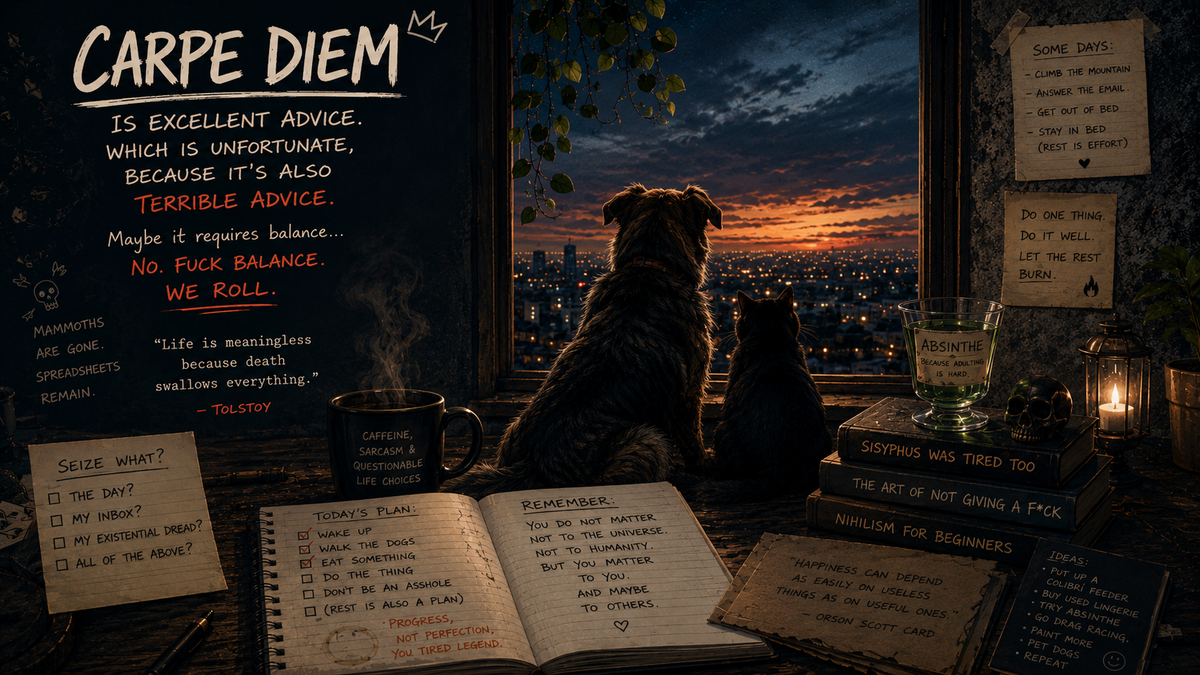
So there, I said it: carpe diem is excellent advice.
Which is unfortunate, because it’s also terrible advice.
Maybe it requires balance…
No. Fuck balance. We roll.
So, yeah, Tolstoy said it better:
“Life is meaningless because death swallows everything.”
Good work, people.
Happy Monday.
Let’s wrap it up here.
Wait, what?
Really?
I’m a sucker for bleakness. I enjoy a good existential void as much as the next clinically overcaffeinated mammal. But damn, bro, maybe smell the flowers?
They’re plants yelling to the world:
“I’m horny.”
There are two opposite camps regarding mortality.
Stoic people tend to think life has meaning because it runs out, and that’s good and all, but what if I’m tired, kind of depressed, and want to spend the whole day in bed?
Where does carpe diem fit into that?
Because “seize the day” sounds heroic when you picture a man climbing a mountain, kissing someone beautiful, or finally quitting his terrible job.
It sounds less heroic when the day is mostly laundry, chest pain, unread emails, and trying to convince yourself that cereal counts as dinner because it has vitamins and you used a bowl.
So what are we seizing here, exactly?
The day?
Or the obligation to perform being alive with enthusiasm?
The reality of the modern world is that it has made days kind of unseizable.
They tend to become identical.
Wake up.
Work.
Emails.
Groceries.
Repeat.
And sure, let’s not be unfair: this is not a uniquely modern phenomenon. I imagine the days in the hell of Verdun also felt pretty repetitive.
Mud.
Shelling.
Rats.
Terror.
Mud again.
Until, of course, the routine broke, and you found yourself lying there, dying, probably thinking:
“Well, at least today was different.”
Your brain was shaped by evolution to fight lions and hunt mammoths and, kudos everyone, we crushed both assignments.
Mammoths are a distant memory, and killing a lion is now very frowned upon.
But then what?
The whole structure of life changed.
Our instincts did not.
Maybe they can’t.
So now we carry ancient panic inside modern furniture.
The body wants danger, tribe, hunger, sex, fire, movement, weather, story, blood, victory, sleep.
The world gives it spreadsheets.
And then some Roman ghost has the nerve to whisper:
“Seize the day.”
My brother in Jupiter, seize what?
My inbox?
My existential dread?
Wake up.
Go to the gym.
Walk the dogs.
Eat breakfast.
Count the calories, the sugar, and the mystery chemicals that, depending on the week, either cure cancer or turn your pancreas into modern art.
Because otherwise you, proud member of a species that defeated mammoths, crossed oceans, built telescopes, split the atom, and invented five thousand kinds of yogurt, will get fat.
Now the enemy is portion control.
Achilles had Hector.
I have carbohydrates, and my waist says I’m losing the fight.
Leaving the sarcastic outbursts aside and returning, unwillingly, to the matter at hand:
Some changes need to be made.
Not to society.
That takes years and usually ends with someone inventing a flag, a slogan, and digging a mass grave.
No.
Changes to you.
Carpe diem can be valuable advice, but only if your tired, overworked, constantly bombarded brain can take what it needs from it and ignore the rest.
The truth — and also the lie — is that each of us is a complex, unique little universe.
One that will cease to exist the moment we die.
And each of those universes has different rules.
Different needs.
Different fears.
Different operating systems held together with duct tape, childhood trauma, caffeine, and delusion.
So “seize the day” cannot mean the same thing for everyone.
For one person, it means climbing a mountain.
For another, it means answering the email.
For another, it means getting out of bed.
For another, it means staying in bed, because the body finally filed a formal complaint and, for once, management should listen.
Because taking no action is also taking action, and sometimes rest is an effort.
“Live each day like it’s your last” is excellent advice.
I spent a good part of my youth following it, and it gave me anxiety.
“What will dying Sisyphus think about this?” is a question you can only ask yourself a couple million times before it drives you insane.
Hence the nihilism, I think.
I ended up moving from:
“Every moment is precious.”
to:
“It kinda doesn’t matter.”
And decided instead to look for balance.
The most difficult thing I’ve learned in my life is to do just one thing:
If I’m working, I do that.
If I’m sticking pins into the picture of an enemy, I make sure they’re evenly spaced on their face, on a beautiful grid for better voodoo.
That has replaced carpe diem for me, with advantages.
Will I have to be accountable to dying me in my last moments for everything I did wrong?
Sure.
But it’s impossible to be perfect or ideal.
There’s a kind of savage wisdom to pain.
When you live with pain, you start sifting through life and its multiple possibilities like it’s nobody’s problem, because the pain acts like a filter:
What’s bigger?
Suddenly the weak, fake, or just boring friendships are gone.
The noisy parties you didn’t really enjoy are no longer part of the program.
You end up doing only things you want to put effort into.
I think a good running conclusion to my writing these last few weeks is:
Remember:
You do not matter.
Not to an infinite universe.
Not to a complex world.
Not to an unaccountable humanity.
Not to a traumatized society.
But…
You matter to yourself.
And maybe to others.
(Maybe, because you’re reading me, so…)
All this to say that maybe, you can’t waste time.
Not watching a TV show that you love.
Or reading (or rereading) a book.
Painting.
Walking.
Trying to finally figure out who’s a good boy and who’s a good girl with your dogs.
Because looking at life like one big, sublime commitment turns humanity into a contest and the species into a swarm of locusts.
In this day and age, your obligation to dying you is linked far more to reducing harm than to building new things.
And that makes me think, because this subject emerges in all kinds of books and all kinds of cultures.
And when the thoughts come — and they will — and you have that very common and rational thought:
“I’m alive, ergo I should win a Nobel Prize.”
Remember:
Life is not a contest.
Remember this when things are good.
Keep it in mind when they are bad.
We’re all looking for meaning and legacy one way or another and maybe…
Maybe it comes in the shape of millions of meaningless instants that, viewed through the lens of a life —
A life.
— become meaningful.
So what I’m saying is:
Go big.
But make sure you enjoy it.
Take the pressure out of life as much as you can and instead try to enjoy the ride.
Put up a colibrí feeder.
Buy used lingerie online.
Try absinthe.
Go drag racing.
I don’t know.
I’m tired.
“I will probably end up going, anyway,” said Wang-mu. “But I’ll gladly explain to him why I am now useless in the House of Han.”
“Oh, of course,” said Mu-pao. “You have always been useless. But that doesn’t mean you aren’t necessary.”
“What do you mean?”
“Happiness can depend as easily on useless things as on useful ones.”
— Xenocide
Now shuuuu.
Go sleep.
It’s late.
And whatever you do: Protect your finite attention from things who profit by convincing you your existence must constantly justify itself.